In 'The Sun' on Wednesday there was an article about one of the fights of Thomas Sayers, the boxer mentioned in a previos post. The article is available at the link at the below.
http://www.thesun.co.uk/sol/homepage/features/2940920/Recounting-the-first-ever-boxing-World-Heavyweight-fight.html
Friday, 23 April 2010


Monday, 19 April 2010
Cemetery Symbols: The Urn
One of the many statues that can be placed on a grave site that has a symbollic meaning is that of the Urn. If the Urn is shown half covered by a cloth, it shows that the deceaseds family believes in reincarnation, the space left by the absense of cloth allows for the soul to leave the Urn to be reincarnated. If, however, the Urn is completely covered by a cloth then reincarnation is not believed in. The cloth does not need to leave a space as the soul cannot move on after the body has died. The two photographs below to show these beliefs were both taken in Highgate Cemetery.


Friday, 16 April 2010
Highgate Cemetery: East
When i visited Highgate Cemetery I explored the East side as well as the West side. The East side is still a working cemetery and so there are a lot of newer graves than there are in the West side, there are also a few unique and interesting memorials worth seeing.
The East side is best known for being home to the tomb of Karl Marx, which is impossible to miss seems to be constantly surrounded by a swarm of tourists. It has been so well documented, though, that it didn't seem that special to me.
 One of the first graves as you enter the East side of the cemetery belongs to Anna Mahler, a sculpture. The memorial on her grave is a copy of one of her own sculptures which gives it a great sense of uniqueness.
 Another grave close to the entrance is of Douglas Adams, writer of 'The Hitchhiker's Guide to the Galaxy'. The memorial in itself is very plain but what maked it interesting is the small toys that have been left by fans on top of the stone.
 Despite still being a working cemetery with many modern graves the cemetery was unused for such a long time that there are still many graves that are enshrouded with ivy and other plant life, there are also many narrow winding paths crisscrossing the cemetery but these are so overgrown that you are unable to walk down them.


The East side is best known for being home to the tomb of Karl Marx, which is impossible to miss seems to be constantly surrounded by a swarm of tourists. It has been so well documented, though, that it didn't seem that special to me.
One of the first graves as you enter the East side of the cemetery belongs to Anna Mahler, a sculpture. The memorial on her grave is a copy of one of her own sculptures which gives it a great sense of uniqueness. Another grave close to the entrance is of Douglas Adams, writer of 'The Hitchhiker's Guide to the Galaxy'. The memorial in itself is very plain but what maked it interesting is the small toys that have been left by fans on top of the stone.Despite still being a working cemetery with many modern graves the cemetery was unused for such a long time that there are still many graves that are enshrouded with ivy and other plant life, there are also many narrow winding paths crisscrossing the cemetery but these are so overgrown that you are unable to walk down them.
Monday, 12 April 2010
Highgate Cemetery West: Mary Nichols: The Sleeping Angel
The tomb of Mary Nichols lay hidden in ivy for many years until it was discovered by photographer John Gay in the 1980's, it now is clear for all to see. The tomb shows an angel asleep upon a bed of clowds.

Not much is know other Mary Nichols other than she died in 1909 of diabetes and heart failure and was the wife of a bank and insurance manager. She is however one of the most beautiful statues in any cemetery I have ever seen.

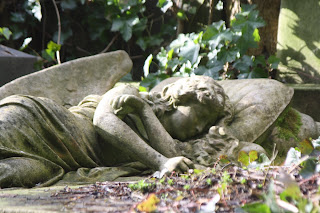
Not much is know other Mary Nichols other than she died in 1909 of diabetes and heart failure and was the wife of a bank and insurance manager. She is however one of the most beautiful statues in any cemetery I have ever seen.


Friday, 9 April 2010
Highgate Cemetery West: Thomas Sayers
 Thomas Sayers was the first man to be declared the World Heavy Weight Champion in the sport of Boxing. Throughout his career he was only ever defeated once. When he retired he settled in a house in Camden where he was often seen driving his carriage up and down the streets with his Bull Mastiff 'Lion'.
 He died at the age of 39 of Tuberculosis and Diebeties. At the time of his death he was so famous that his funeral was attended by ten thousand people. His friends pulled together to pay for his tomb, which bears a statue of his beloved dog.
 More about Sayers can be found here:
Monday, 5 April 2010
Highgate Cemetery West: Nero the Lion
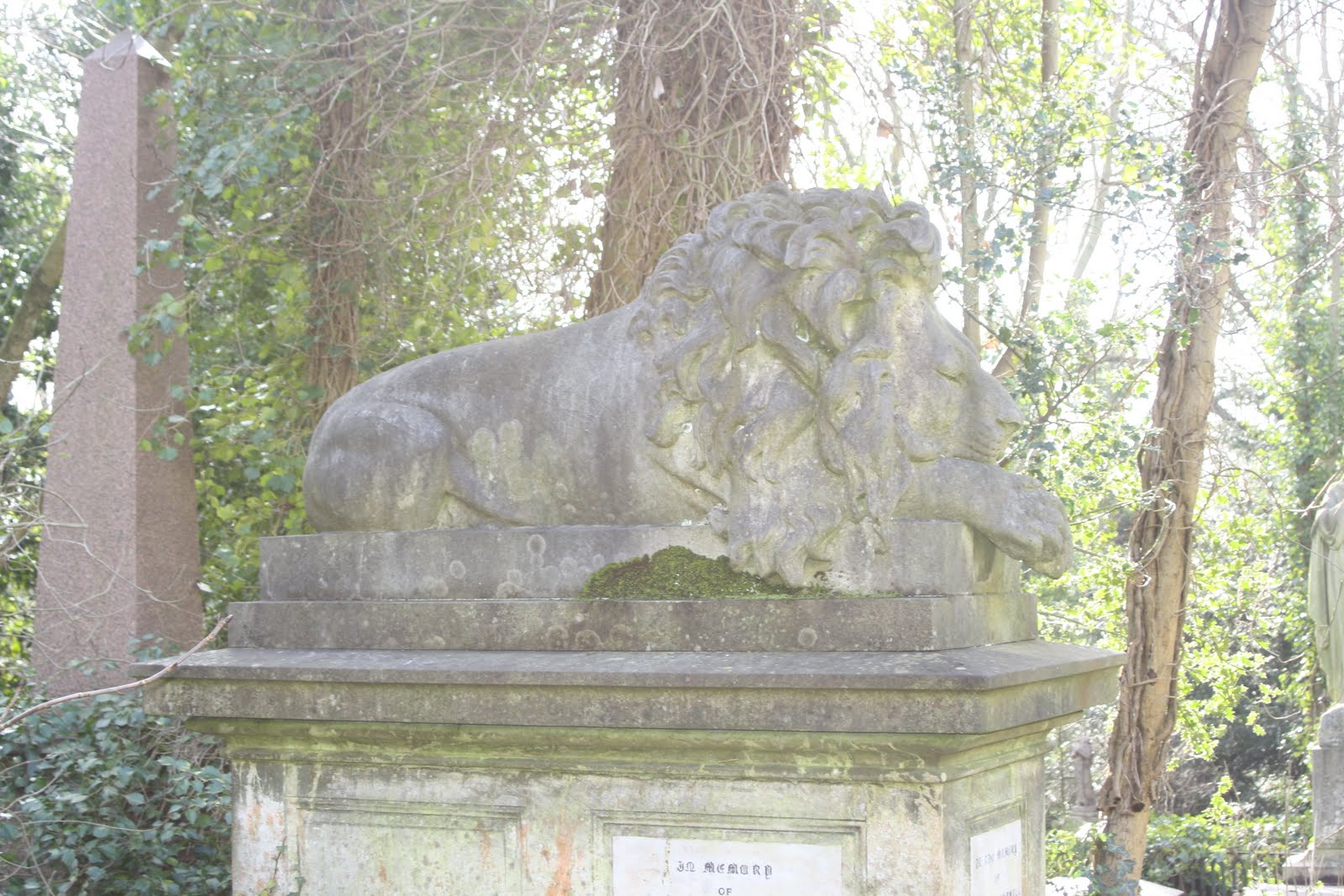 The majestic lion Nero was the pet of George Wombell, the proprietor of the worlds largest menagerie in the early nineteenth century, and now he lies guarding his grave.
Wombell started out displaying two Boa Constrictors for a penny a view in London's taverns, and slowly moved on to more and more exoctic animals that many people would never have otherwise seen.
He became a favourite in the Royal Court and appeared three times before Queen Victoria. He died in 1850.

More information on Wombell can be found at the following:4
Friday, 2 April 2010
Highgate Cemetery West

Being probably the most famous cemetery in I had to visit Highgate. The cemetery is split in to two halves, East and West. In the East side you can wander alone but in the West you are only permitted to enter if taking part in a tour, which lasts approximately an hour but you could easily spend a full day wandering this half alone. The pace of the tour does not really allow much time for quality photographs but what I managed to capture the best will be shown in the next few post. Below I have included a few interesting things that I spotted that would not fill an entire post to themselves.
What is described as the most talked about grave in Highgate is pictured below, it is the oldest grave in highgate cemetery, the deceased was 36 when she died, one year older than the average death age.
 Also spotted was this example of a death mask. A death mask is an actual mold of the deceased face that is then turned into a mask and put upon a memorial statue. This creates a copy of the deceased faces on their memorial.
 This tecnique was also used at Highgate in the tomb of Julias Beer, which is the cemetery's highest point. In this tomb a child, with the face of his deceased daughter, is being carried off to heaven by an angel. It is prohibited to photograph inside of the tomb but I'd recomend visiting the cemetery to see it.
Subscribe to:
Posts (Atom)